Governance and Compliance
Goal and Performance Highlights

Performance
Goal
Challenges and Opportunities
Central Pattana Public Company Limited conducts business by adhering to the principles of corporate governance and systematic risk management. This is considered the key to creating sustainable value and building confidence for all stakeholders throughout the value chain. However, amidst a highly volatile business environment, the Company is aware of important challenges and opportunities as follows:
-
Governance Complexity Across the Organization: The Company faces challenges in maintaining consistent ethical and compliance standards across its diverse business units, including investment, business development, construction and real estate management to ensure that the corporate governance policy will be concretely implemented in all jurisdictions in which the Company operates. running a business
-
Changes in Regulations and International Standards: The legal environment and sustainability requirements are continually changing. both nationally and internationally. For example, the 10 international principles of the UN Global Compact require the Company to monitor, improve, and adapt in a timely manner to prevent risks from practices that violate the law, ethics, and business ethics.
-
Cybersecurity and Data Governance: As part of enterprise risk management, the Company is committed to supervising personal data in accordance with the Personal Data Protection Act (PDPA) and international standards. The Company focuses on laying the foundation for transparent and verifiable data governance to prevent incidents that may affect the basic rights of stakeholders, as well as confidence in corporate governance and the organization's reputation in the long run.
-
Risks from Business Expansion and Investment: In the due diligence process before a merger or joint venture, companies face the challenge of conducting due diligence and evaluating ESG risks in both the short and long term. This is to ensure that new partners conduct business according to the same ethics.
-
Creating a Competitive Advantage through Good Governance: The Company sees an opportunity to enhance the organization's trust and reputation through having a strong sustainability operating structure. This will help increase confidence among investors and business partners in the long run.
-
Ethical Organizational Culture: Cultivating values and organizational culture based on ethics. Employees at all levels will be encouraged to be responsible and strictly follow ethical standards. Helps reduce the risk of corruption and actions that violate regulations.
-
International Cooperation for Sustainability: Becoming a member of global organizations such as the UN Global Compact and members of the Thai Private Sector Collective Action Coalition Against Corruption (CAC), including operating according to good corporate governance standards. It is an opportunity to access the knowledge base and international partner network to develop sustainability practices to be ahead of the competition

Furthermore, implementing effective risk management and regulatory compliance frameworks enhances operational efficiency, mitigates legal risks and penalties,
and builds lasting confidence and engagement across stakeholder groups.
Management Approach and Value Creation
Central Pattana Public Company Limited prioritizes good corporate governance and conducts business with transparency, ethical integrity, and adherence to governance principles to build trust among all stakeholder groups across the value chain. Effective corporate governance, together with systematic risk management, serves as a critical mechanism for reinforcing business stability and promoting sustainable value creation.
The Company is committed to conducting business in accordance with relevant international standards, including the UN Global Compact, which covers human rights, labor practices, environmental responsibility, and anti-corruption. The Company also places strong emphasis on ESG practices to ensure that its operations align with sustainable development goals and generate positive impacts on society.
In addition, the Company integrates environmental, social, and governance risk management into its enterprise risk management framework to address key short-term and long-term risks, including climate-related risks in accordance with the IFRS S2 framework. Proactive measures have also been established to mitigate risks that may affect the Company's Net Zero target by 2050.
Central Pattana Sustainability Management Policy
Central Pattana Sustainability Management Policy reflects the commitment to operating and growing the business sustainably while caring for and protecting the environment, society, and governance (Environment, Social, and Governance: ESG). Under the vision "Imagining Better Futures for All", the policy supports long-term shared value creation with stakeholders across all sectors, aligns with global trends, and supports the United Nations Sustainable Development Goals (UN SDGs).
The Company reviews the policy and submits it to the Corporate Governance and Sustainable Development Committee every year so that the policy remains current with global conditions and the organizational context. Details of the policy are disclosed on the Central Pattana website under Sustainability / Central Pattana Sustainability / Sustainability Policy.

Strong Governance Structure
Central Pattana Public Company Limited has established the Corporate Governance and Sustainable Development Committee as the primary body overseeing the Company's governance and sustainability agenda, together with the Audit and Governance Committee, which is responsible for reviewing operations to ensure compliance with applicable laws and relevant standards. The Company has also established corporate governance and business ethics policies to guide employees, executives, and business partners in operating under a common direction, while upholding the principles of transparency and accountability.

Adhere to the principles of transparency and responsibility.
In addition, the Corporate Governance and Sustainable Development Committee plays a key role in overseeing corporate governance, sustainability, and key risk management policies, while closely monitoring progress against the Net Zero target and ESG strategy through regular performance review meetings.
In addition, the Company has clearly specified duties and responsibilities related to oversight of climate-related risks and opportunities in the charters of relevant committees, and has expanded these responsibilities to cover the office, hotel, residential, and real estate investment trust (CPNREIT) businesses.
Remuneration Structure Linked to Sustainability Performance
The Company determines performance evaluation and remuneration based on objective-driven outcomes. Objectives and Key Results (OKRs) are used as the main mechanism to define, monitor, and evaluate the performance of the Chief Executive Officer, senior executives, and employees at all levels. The OKR framework is structured across four main dimensions: finance, business, environment and sustainable development, and people. This ensures that performance outcomes are systematically connected to the strategic direction, aligned with Agile ways of working, and clearly and transparently reflected in performance-based remuneration.
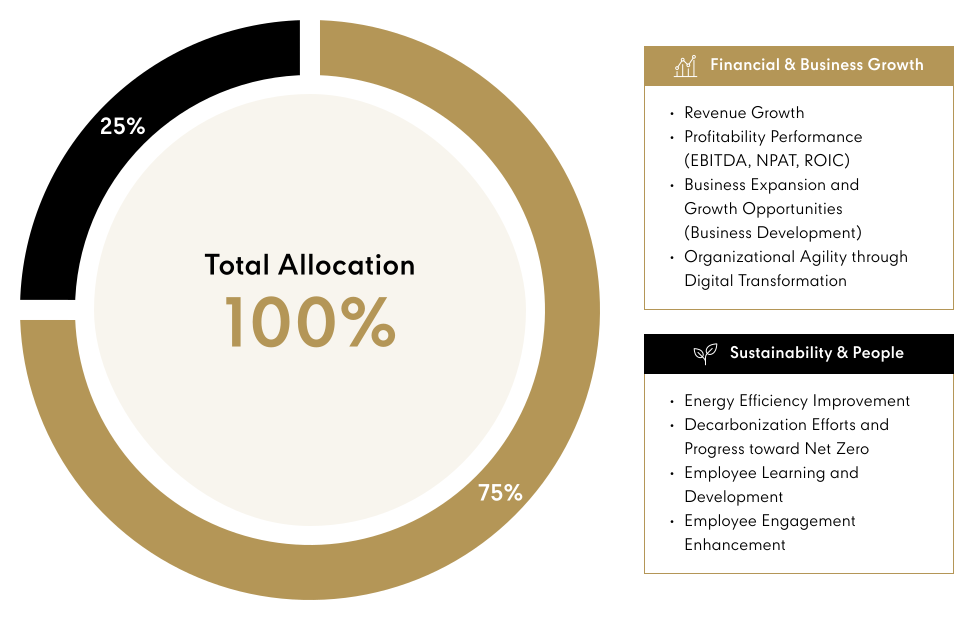
Furthermore, to balance financial performance with sustainable value creation, the Company applies a performance evaluation framework in which financial and business development KPIs account for 75% of the overall assessment, while sustainability and people-related KPIs account for the remaining 25%. Performance outcomes are directly linked to remuneration and incentive decisions for executives and employees, encouraging the achievement of business objectives alongside environmental stewardship, social responsibility, and human capital development. This remuneration structure supports the integration of sustainability considerations into day-to-day management and long-term value creation.
- Financial indicators include Revenue Target, Earnings Before Interest, Taxes, Depreciation and Amortization (EBITDA), Net Profit after Tax (NPAT), and Return on Invested Capital (ROIC), as well as share price growth compared with peers in the same industry.
- Business development, commercial, and digital transformation indicators include the successful development of new projects according to strategic plans, collaboration with business partners, customer and tenant satisfaction, and progress in applying digital technology to improve operational efficiency, deepen customer understanding, and expand digital service channels.
- Environmental development indicators include energy efficiency, greenhouse gas emissions reduction, and resource management in support of the Net Zero target.
- People indicators include employee development, employee engagement, employee productivity and effectiveness, and succession management for executive-level employees.

The remuneration structure comprises:
- Fixed remuneration, including salary and benefits such as provident fund contributions, medical expenses, accident insurance, travel insurance, and life insurance. These are determined based on roles, responsibilities, experience, skills, expertise, and leadership. Remuneration is reviewed annually based on performance compared with targets and work plans, and is benchmarked against market rates in the same industry to retain high-potential talent. The structure also includes preparation and support in cases of retirement, resignation, health issues, disability, or death.
- Short-term variable remuneration refers to annual bonuses paid in cash based on actual performance achieved in the previous year compared with targets measured through OKRs across different dimensions.
- Long-term incentives include accumulated shares under the Employee Joint Investment Program (EJIP). The Company encourages executives to participate in Company ownership through a five-year share accumulation program. The Company contributes 100% of the accumulated employee contribution, equal to 5% of salary, to create incentives for stable long-term organizational growth aligned with shareholder interests.
- Clawback Provision: The Company operates in strict accordance with governance principles and has a clawback provision under Sections 89/18 and 89/19 of the Securities and Exchange Act. The provision applies when dishonest conduct or performance information distortion is identified, helping ensure transparency and protect the best interests of stakeholders.
Process for Setting Sustainability Performance Indicators
The Company has established a process for cascading indicators to the operational level to drive tangible action across the organization as follows:

-
Identification of material sustainability topics based on double materiality assessment (Double Materiality Assessment - IRO Framework): The Company identifies and assesses material sustainability topics across three dimensions under the IRO principle, which evaluates impacts, risks, and opportunities.
- Impacts: The Company analyzes actual or potential impacts from Company activities on the environment and society (inside-out).
- Risks and opportunities: The Company analyzes financial risks and opportunities where external sustainability factors may affect business value and stability (outside-in). The information is used to prioritize topics and define sustainability strategies that genuinely address stakeholder needs.
- Cascading: The Company cascades targets to committees, working groups, and relevant functions in sequence across departmental, functional, branch, and business group levels.
-
Weighting and Prioritization: To ensure that evaluation is aligned with context, the Company applies the following approach to indicator weighting:
- Strategic Alignment refers to weighting based on the materiality level of IROs for each topic, focusing on a balance between managing negative impacts and capturing business opportunities.
- Role-Based Relevance refers to adjusting indicator proportions in line with duties and responsibilities at appropriate levels.
- Dynamic Adjustment refers to reviewing weighting based on the Agile concept to keep pace with changes in material topics that may shift according to global circumstances.
- Monitoring and Communication: The Company continuously monitors results and communicates the overall progress to employees twice a year through Corporate Townhall meetings, enabling employees to share the same goals and adapt effectively to new challenges.
Applying Internal Carbon Price (ICP) to Assess Risks and Opportunities
The Company applies Internal Carbon Price (ICP) criteria as an important financial tool for monetizing climate-related impacts, risks, and opportunities (Monetization of Climate-related IROs) in accordance with IFRS S2. The approach covers two main dimensions:
- Transition Risk Valuation uses ICP to simulate potential increases in future business costs from carbon tax measures and electricity price volatility, reflecting expected financial impacts.
- Opportunity Valuation uses ICP to help calculate the real return on investment in low-carbon technologies, demonstrate Avoided Cost, and support capital allocation toward environmentally friendly projects.

Risk Management and Compliance throughout the Value Chain
Central Pattana Public Company Limited conducts risk management at the enterprise level through the Enterprise Risk Management process, which covers analysis and assessment of both short-term and long-term risks, especially ESG, in order to be able to effectively predict and manage challenges that may affect the business, as follows:
Due Diligence uses a process to examine and evaluate both short-term and long-term ESG risks in all important activities to prevent actions that are against the law and ethics
Business partner supervision: Encourage suppliers to conduct business under the Supplier Code of Conduct and Code of Conduct to create a transparent value chain.
You can study more details about the Company's supply chain management (partners) at: Supply Chain Management

Covers both short-term and long-term risk analysis and assessment
Data Governance and Cybersecurity It has established a cyber risk governance framework under the supervision of the Audit and Governance Committee to protect the information and rights of stakeholders in accordance with the organization's data governance policy. Ready to promote the development of knowledge and understanding of cybersecurity for employees at all levels to strengthen immunity and readiness to deal with digital threats that may occur at every point in the value chain.
You can learn more details about the Company's cybersecurity and personal data protection at: IT Security, Cybersecurity and Personal Data Protection
Whistleblower System and Anti-Corruption Measures
Central Pattana Public Company Limited has established a Whistleblower channel that enables employees and stakeholders to report suspected fraud or violations of the company's Code of Conduct. All reports are reviewed by the Internal Investigation Committee and followed up through appropriate corrective actions.
The Company has continuously and systematically implemented anti-corruption measures, maintaining certification as a member of the Thai Private Sector Collective Action Against Corruption (CAC). The Company also conducts annual reviews and enhances fraud prevention processes across all levels of the organization to foster a corporate culture of transparency, integrity, and accountability to all stakeholders. Further information on the Company's corporate governance is available at: Corporate Governance at a Glance

Promote a corporate culture of transparency, integrity and accountability to all stakeholders.
Stakeholders Directly Impacted

Tenants and Lessees (Retail and Offices) and Residential Customers

Employees

Customers

Suppliers and Business Partners

Community/community representatives including regulatory agencies, government, academia and independent organizations.

Shareholders