Waste Management and Circular Economy
Goal and Performance Highlights
The Company has established a sustainability strategy with the Circular Economy as its centerpiece under the Journey to Zero project. This strategy reflects the Company’s commitment to achieving its goal of reducing landfill waste to zero and forms an important part of its organizational transformation plan toward achieving net-zero greenhouse gas emissions by 2050.
Performance
Goal
Short-term goals for 2025
Medium-term goal for 2034
Long-term goals for 2050
Governance and Oversight
Central Pattana drives the climate and environmental policy from the Board of Directors level through cross-functional implementation. The Company has appointed the Journey to Zero Working Group, comprising executives from the head office and representatives from all branches. The working group is responsible for setting strategies, implementing waste separation measures, and closely monitoring operational performance. The working group reports directly to the Climate and Environment Committee and the CSV (Creating Shared Value) Committee to ensure that waste management practices are aligned with the Company’s Net Zero target by 2050 and overall business goals.
Challenges and Opportunities
Responsible waste management is considered a material issue that all stakeholders attach great importance to. As a leading developer of shopping centers and real estate, the Company manages a significant amount of waste generated from its daily operations, including waste from stores, tenants, and customers, as well as waste generated during project construction. Waste management is complex and involves more than the provision of necessary infrastructure. Meaningful progress also depends on changes in behavior. Although waste separation at source is widely recognized, achieving tangible results requires appropriate support, participation, and motivation from all sectors.
The Company recognizes transition-related risks, including stricter environmental regulations and the likelihood of higher waste disposal costs. Central Pattana also acknowledges the risk of causing negative impacts on the environment and surrounding communities if waste is not managed effectively. In addition, tracking and analyzing waste data is considered central to strategic planning. A transparent and efficient data collection system enables the Company to assess risks, set targets, and accurately measure the outcomes of waste reduction measures in accordance with international disclosure standards.
Amid these challenges, the Company sees an opportunity to turn limitations into competitive capabilities. Efficient waste separation and reuse not only help avoid and reduce operating costs, known as Avoided Costs, but also create new business opportunities. The Company therefore places importance on fostering a culture of responsibility within the organization and among business partners, employees, and consumers. We drive this approach through projects and activities that make waste reduction easier and more accessible for all. Collaboration among stakeholders helps create a positive impact by encouraging behavioral change and significantly reducing the amount of waste sent to landfill.
In addition, building partnerships among the public sector, private sector,
and local communities is another key driver that helps improve the efficiency of waste management.
Management Approach and Value Creation
The Company recognizes the challenge of changing consumer behavior, as well as the relationship between waste volume and financial impact. From the perspective of stores and tenants, an increase in waste is often directly related to a higher number of visitors, which may contribute to higher revenue. From the waste management perspective, however, higher volume of waste leads to increased disposal costs and regulatory compliance costs. The Company therefore turns these challenges into opportunities to create shared value through the Waste-to-Value concept and cost avoidance. To support this approach, the Company has developed strategies across the value chain as follows:
Upstream – Construction Waste Management
To raise waste management standards in construction areas in line with circular economy principles, the Company has established an operational framework based on the Construction Waste Management Manual. This framework covers the entire process, from waste separation at source to final waste management, while integrating financial incentive mechanisms and creating shared social value to encourage contractors to participate in a concrete and meaningful way.
The process consists of three steps, as follows:
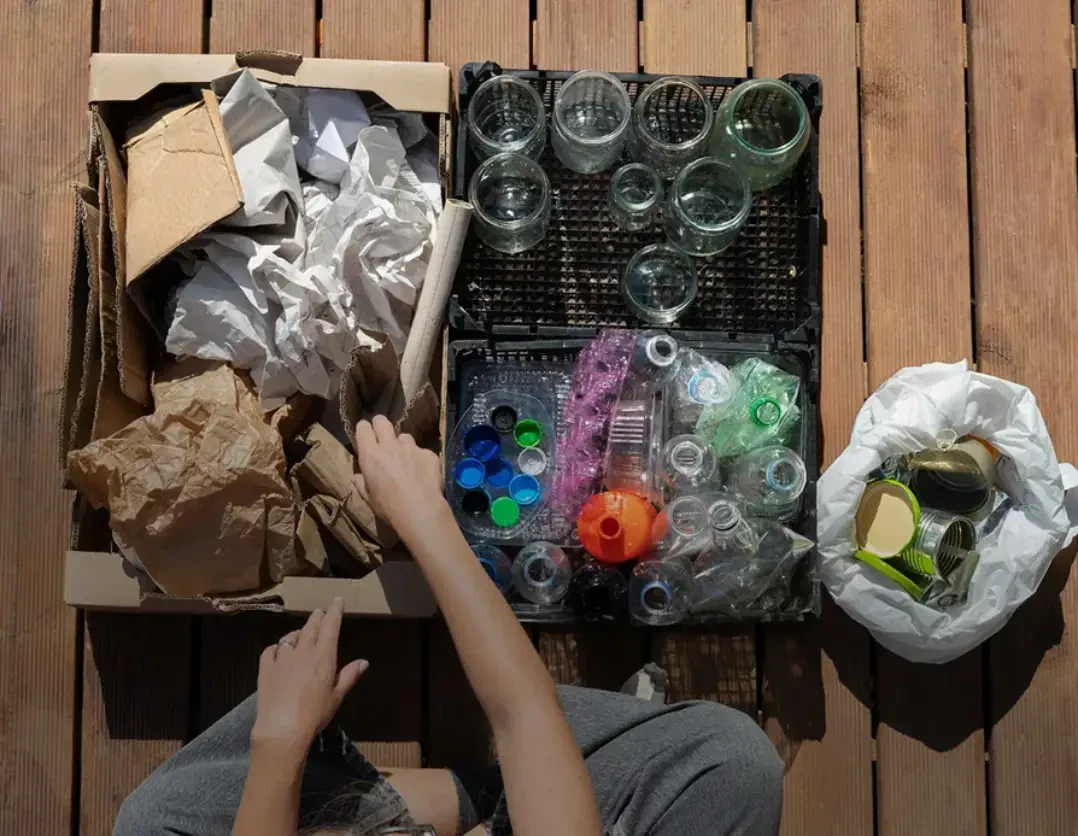
Support systematic waste separation.
Classification and Separation of Waste at Source
The Company specifies waste management requirements as part of the Terms of Reference (TOR). These requirements cover the management of(1) waste from demolition, (2) waste from construction scraps, (3) waste from labor in worker camp accommodations, and (4) general solid waste. Contractors are required to provide waste sorting bins for four types of waste: wet waste, recyclable waste, hazardous waste, and general waste. They must also provide communication materials to educate workers on proper waste separation and report waste management performance on a monthly basis. These requirements are designated and enforced in new shopping center construction projects and renovation projects, covering more than 50% of all new real estate development projects undertaken by the Company. Contractors in all project areas are required to comply with these requirements.
Destination Management and Resource Flow Processes
Sorted waste is managed to recover as much value as possible through four approaches: sales, donations, sanitary landfill, and resource processing or recycling across projects. The Company has achieved tangible results as follows:
-
Reuse
- Structural and architectural work, such as dismantled steel roof structures from parking areas are converted into Solar Carport frames for parking buildings. Original materials that remain in good condition, such as tiles, columns, walls, and flooring, are also reused for decoration and other purposes.
- Temporary equipment is reused across projects, including 40 rotating shipping containers used as site offices and worker accommodations, temporary partition walls or hoarding, metal roof sheets, and electrical transformers.
- Earthwork, such as soil excavated during construction is transported for use in land filling and ground-level adjustment in other project areas within the Group.
-
Recycling
- Construction material waste: Under the CECI network, the Company has participated in sorting gypsum boards for use in producing new boards. Importantly, pile heads are also converted into recycled concrete aggregate (RCA), which is used as a temporary substitute for crushed stone in road paving. A total of 10,000 tons of material has been processed, helping reduce greenhouse gas emissions by more than 900 tons of carbon dioxide equivalent.
- Organic waste from labor: Promote self-reliant waste recycling in worker camps by using food scraps and vegetable and fruit scraps to make biological fermentation (EM) to treat wastewater at the work site. Composted into fertilizer and raising earthworms. The resulting fertilizer will be used in the vegetable garden to provide food welfare to the workers. The surplus produce will be sold to recirculate the income to buy food and stationery to support children in nearby communities.
-
Creative Reuse (Upcycle & Social Value)
- Converting waste materials into public benefits Contractors manage leftover concrete scraps from daily work by pouring and forming them into concrete slabs. These slabs are used to improve the landscape in worker camps, offered to temples, and donated to communities for public benefit.
- Project decoration The Company purchases loose furniture made from processed waste materials to decorate sample rooms and clubhouses, as well as to provide seating in common areas.
- Creating motivation through community-based approaches: Leftover food scraps are used as animal feed for egg-laying ducks. The eggs produced are then used as rewards for workers who bring in recyclable waste for exchange. This initiative helps reduce landfill waste while improving workers’ quality of life.
Financial Incentive Mechanism
To maximize the efficiency of waste separation and reduce the amount of waste sent to landfill, the Company has established a policy whereby all income and expenses from waste management are treated as the rights and benefits of contractors. This mechanism creates positive incentives and encourages contractors to take a proactive role in creating additional value from waste, whether through sale, processing, or reuse for welfare purposes, instead of sending waste for disposal, which involves higher costs.
Midstream - Waste Management from Operations and Internal Organizational Activities
The Company is committed to raising operating standards to excellence. Central Pattana starts with building a strong culture within the organization and expand the results to systematic management of shopping center areas. through the following mechanism.
To strengthen the reduction of greenhouse gas emissions from waste management.
Management Structure and International Standards
- Journey to Zero Working Group The Company has established a cross-functional team comprising members from the head office and representatives from all branches. The working group is responsible for jointly setting targets, exchanging best practices, and presenting performance results to the Climate and Environment Committee.
- ISO 14001 standard: the Company upgrades the waste separation and disposal process by requesting ISO 14001 environmental management system certification to cover shopping center areas nationwide to ensure that the waste management process meets international standards and can be verified.
Waste Management Within the Organization
The Company instills environmentally friendly values in employees through waste management practices covering two main areas: waste from operations, such as repair work, demolition, marketing activities, and office equipment; and solid waste generated from employee consumption. These practices are guided by the 3Rs principles through the following waste management strategies:
- No-desk-bin Policy: The Company has introduced a No-desk-bin Policy to encourage behavioral change among employees by replacing individual desk trash bins with centralized waste sorting stations. Waste is carefully separated into nine categories: food waste, liquid waste, plastic bottles for recycling, paper, cardboard, aluminum cans and glass bottles, hazardous waste, electronic waste, RDF waste, and general waste. This helps reduce contamination at source.
- Final waste management process: All waste is sorted and managed through appropriate methods, including sale, donation, processing, and disposal, with the aim of sending as little waste as possible to landfill.
- Creating culture and motivation: The Company continuously promotes waste separation awareness through e-learning and workshop training. It also organizes the One Recycling Drop a Month campaign every Wednesday and Thursday in the last week of each month to encourage employees to bring recyclable waste from their homes in exchange for The 1 points. In addition, competitions are organized among branches to further motivate
Certification of Achievement in Reducing Greenhouse Gases
The Company’s commitment to waste management has resulted in continuous certification under the Low Emission Support Scheme (LESS) by the Thailand Greenhouse Gas Management Organization (TGO). The certification evaluates and verifies the amount of greenhouse gas emissions reduced through three main activities: sorting recyclable waste; producing compost and animal feed from organic waste, such as food scraps; and sorting UHT cartons.
Downstream - Customer, Partner, and Community Engagement
Reducing waste at the national level requires the collective efforts of all stakeholders. The Company therefore transforms its shopping center spaces into platforms for driving changes in consumer behavior through collaborative projects with various sectors, as follows:
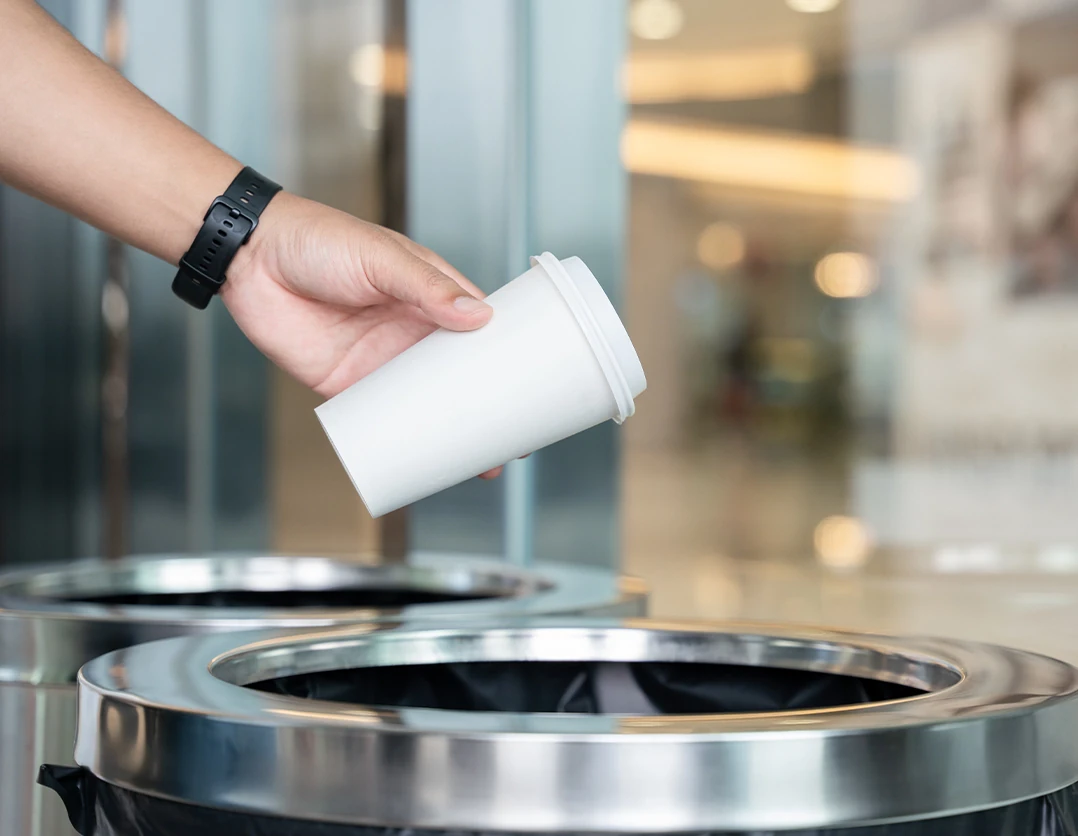
Infrastructure Innovation for Customers
- Three-category waste sorting stations: The Company provides waste sorting stations for three types of waste: general waste, recyclable waste, and hazardous waste. In addition, dedicated bins are provided for clear plastic bottles or PET bottles to support the collection of used plastic, or post-consumer recycled (PCR) plastic, and return it to the production process in line with circular economy principles.
- Recycling drop-off points: The Company has installed automated Refund Machines to collect PET bottles in exchange for The 1 points. It has also set up Klong Ting Dee boxes in shopping centers as collection points for clean plastic and cardboard.
- Recycle Stations: In collaboration with the startup platform Recycle Day, the Company has established permanent waste sorting drop-off points and organized roadshow activities to encourage customer participation.
- Green marketing campaigns: The Company periodically organizes green marketing activities by integrating The 1 loyalty points system and the Central X application to offer rewards and discount coupons, creating incentives for customers to separate waste sustainably.
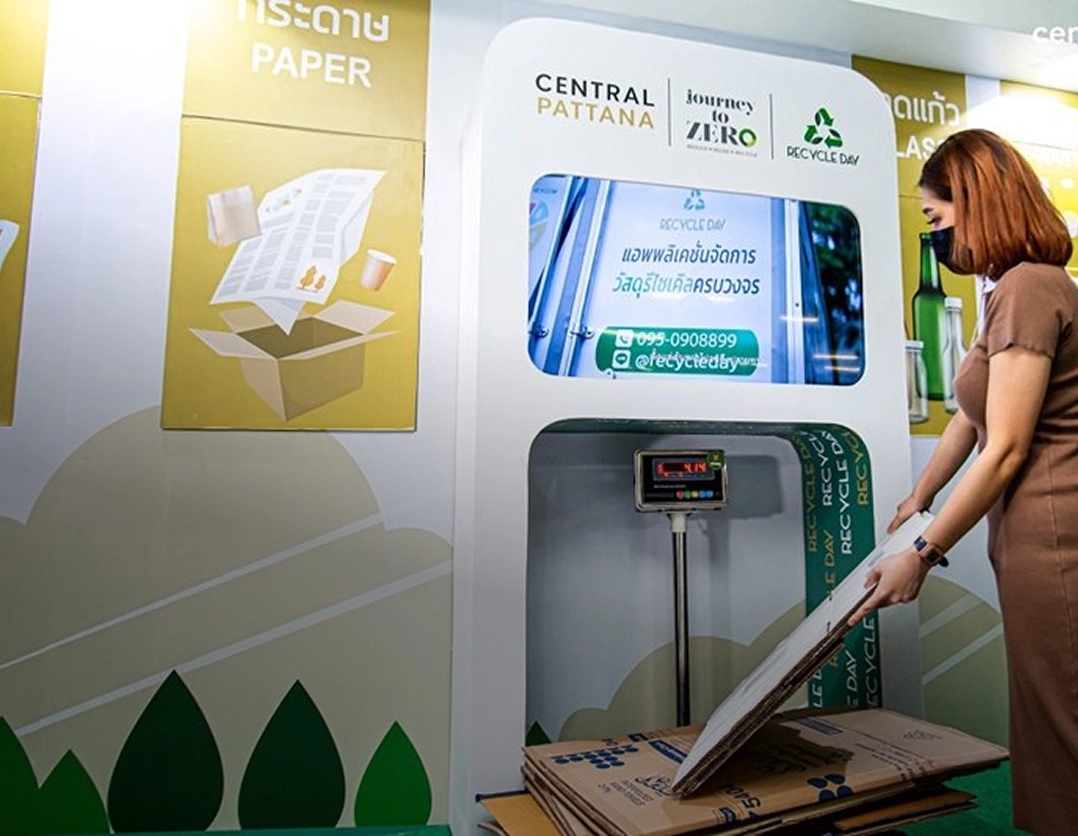
Install recycling separation stations (Recycle Stations) within the shopping center.
Joining Forces with the Government Sector and Sustainability Networks.
- Upgrading organic and hazardous waste management: The Company collaborates with the Bangkok Metropolitan Administration (BMA) under the No Dumping project to expand food waste separation practices in shopping centers and office buildings. In addition, the Company works with the Pollution Control Department by providing shopping center spaces as collection points for hazardous waste from local communities.
- Reduce plastic use: The Company collaborates with the PPP Plastics network through the Bag Trash by Magic Hand project to collect stretchable plastic waste. We also participates in the Bottle Free Seas project to encourage the use of personal water bottles and reduce waste from single-use plastic bottles.
- Creating value for society: The Company participates in the Green Shelter: Collecting Boxes to Build Houses project in collaboration with the Friends in Need (of “PA”) Volunteers Foundation and Tetra Pak. Through this initiative, cleaned UHT cartons are recycled into construction materials and donated to disaster victims.
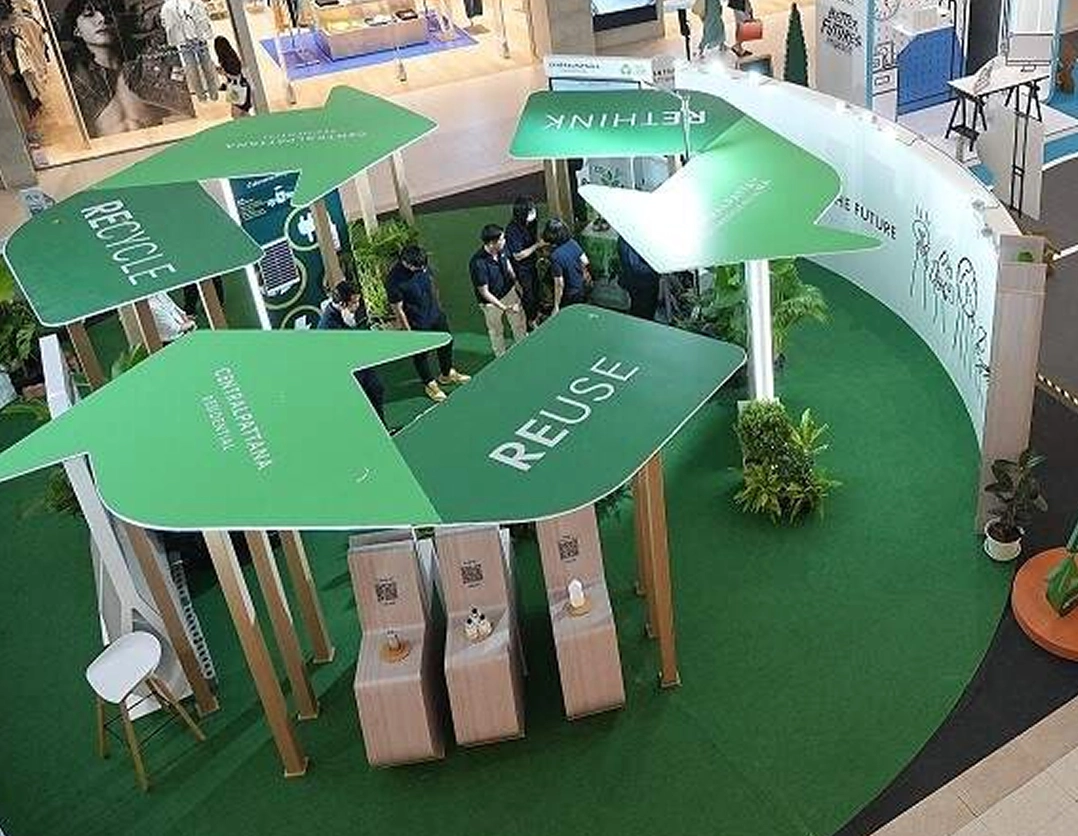
Green Partnership to help reduce waste and reduce carbon footprint.
Driving Collaboration with Partners
The Company collaborates with business partners to take back specific types of waste and properly return them to the circular economy process, as follows:
- Electronic Waste (E-Waste) together with AIS set up electronic waste sorting bins for safe disposal and recycling.
- Clothing and Textiles joins forces with Sabina under the campaign “Take it off and go anywhere” by setting up a box to receive donations of old underwear to turn into clean energy.
- Beverage Packaging joins with Nestle in the project “Restore life to plastic bottles” by campaigning to separate drinking water bottles in the food park.
Risk Management
The Company has begun considering waste management issues for integration into its enterprise risk management system. This enables the Company to monitor and prepare for challenges that may affect business operations, with a focus on the following key areas:
- Regulatory preparation: By regularly following trends in changes in laws and environmental regulations related to waste management to improve operational guidelines within shopping centers and construction projects to be consistent and up to date with the situation.
- Data accuracy supervision: The Company places importance on developing a systematic waste data collection and monitoring system to evaluate the effectiveness of waste reduction measures and enhance transparency in performance reporting in accordance with the organization’s sustainability goals.
- Managing impacts on stakeholders and health: By conducting an assessment of risks that may arise from improper waste management. This may affect the health of the area and surrounding communities. Central Pattana focuses on improving efficiency in the waste separation and transport process to meet the required standards to maintain confidence and a good environment for customers, employees, and partners in all project areas.
- Evaluating business opportunities from resource management: The Company evaluates potential business opportunities by turning waste-related limitations into opportunities to create additional value through the Waste-to-Value concept. This includes sorting recyclable materials to reduce operating costs and developing cooperation with partners in the circular economy to create new business models that promote sustainability together with partners and communities in a concrete manner.

Risk Management
Stakeholders Directedly Impacted

Suppliers and business partners

Shareholders